June 12,2025 - Impact is often seen as the result of good investing. At VP Capital, it’s built into every step—from the first idea to the final outcome. At VP Capital, we don’t just look at financial returns. We start every investment decision by asking: How can our investments help to shape a better world? That mindset led us to design an impact-first investment cycle that embeds impact into every step of the investment process.
1. Strategy: From the Doughnut to decisions
Our investment strategy starts with impact objectives—not as an afterthought, but as a foundation. Inspired by Kate Raworth’s Doughnut model, we began by identifying the most pressing global environmental and social challenges. This helped us define our impact ambitions, focusing on the areas where we want to make a difference: preserving biodiversity, supporting climate resilience, and promoting social equality.
We developed these ambitions into a theory of change—a framework that clarifies how we, as a family office, can make a meaningful contribution. We then refined our focus areas, particularly within our venture portfolio, where deep domain knowledge helps us to accelerate solutions.
We translated this into asset class targets that show how much capital we aim to allocate to the six solutions tied to our three impact themes by the end of the strategy period.
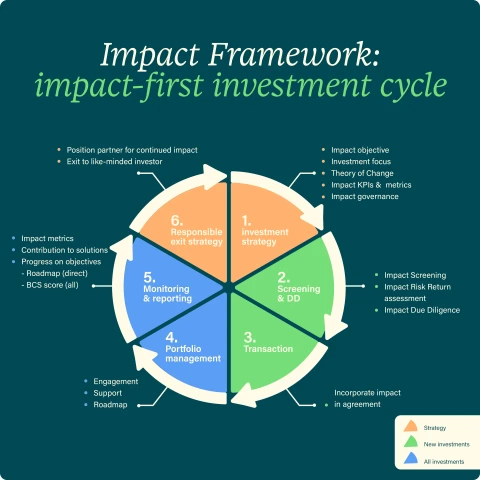
2. Selection: Impact integrated into deal flow
Impact doesn’t just guide our strategy—it’s embedded in our deal flow.
Every proposal is first screened for alignment with our six solutions (net-zero, toxicity-free, circular, bio-based, regenerative and inclusive) in the screening and due diligence phase. We only explore further if there's a clear fit.
To compare very different opportunities, we developed a risk-return-impact (RRI) model, helping us weigh potential investments on three axes:
Risk
Expected Return
Expected Impact
This model allows us to prioritise high-impact investments, even when their financial return might be slightly lower.
The Impact assessment part of the RRI model is inspired by the principles of the Impact Management Project (IMP):
What: Here we assess whether a company’s expected contribution to a solution is relatively small or has the potential to systemically change the industry. For funds, we assess the expected percentage contribution to each of our six solutions.
Who: Here we assess if the investment focuses on making a positive impact on underserved and/or vulnerable people.
How much: Here we assess the size of the expected impact in terms of scale, depth, and duration.
Enterprise contribution: Here we assess how unique the impact will be and consider if there are many other (possibly better) solutions available or if the solution is unique and significantly different to a business-as-usual scenario.
Investor contribution: Here we assess the extent of the capital and knowledge we can provide to the investment.
The Risk assessment includes an assessment of staff competence, financial risks, market risks, ESG risks, and impact risks. The latter assesses the risk that the impact may not occur as expected. Specifically, we assess whether the impact goals are aligned with the overall commercial goals (impact lock-in) and if the team is committed to achieving these impacts.
The Return assessment looks at potential financial returns in relation to the expected time horizon and assesses the likelihood that the investment will become a true game-changer.

3. Structuring: Locking in impact at entry
If an investment passes all the strategic and impact checks, we move forward.
We include impact clauses in our legal agreements, such as annual reporting obligations and sustainability milestones (e.g. switching to green electricity). These terms not only align values, but they often help drive ambitions further. This is where we use our leverage to raise the bar.
4. Active ownership: Collaborating for greater impact
Once an investment is in our portfolio, we stay involved. Whether through board seats, advisory roles or informal support, our goal is to accelerate positive impact and minimise negative effects.
That could involve helping companies calculate their biodiversity footprint, improve their diversity policy, or connect them with innovators in related sectors. Our investment team also facilitates cross-pollination, for example, by linking cleantech and textile strategies through innovative bio-based materials and recycling technologies.
5. Evaluation: Monitoring portfolio-wide impact and learning together
Each year, we assess where we stand—both qualitatively and quantitatively.
We invite all portfolio companies and funds to join our BCS engagement cycle by sharing updates on their climate, biodiversity, and social inclusion progress. We also assess how many of our investments contribute to our six solutions and whether we’re on track to reach our 80% solutions target.
Where possible, we also quantify our impact by collecting metrics such as CO2 avoided, litres of water saved, or hectares of land restored. These insights feed into our annual impact report, where we share our methodology, challenges and progress with full transparency.
The aim of this monitoring process is not just to measure progress, but also to share learning, gain deeper insight into common challenges and trends, and collectively improve outcomes across the entire portfolio. And there’s much to learn from each other along the way.
6. Exit: Ensuring lasting impact
Although we’re long-term investors without a fixed exit horizon, we are always ready for the moment when a transition makes sense. Our goal is to ensure that any buyer or follow-on investor shares our values, so that impact is safeguarded—not undone.
We also define divestment triggers—such as misalignment on impact—which help guide our decisions with integrity.

A model designed to evolve
Our impact-first investment cycle isn’t static. It evolves with insights, experience, and collaboration. But one thing remains unchanged: the belief that capital should contribute to a better future—not just generate returns.
Integrating impact from start to finish: How we designed our impact-first investment cycle